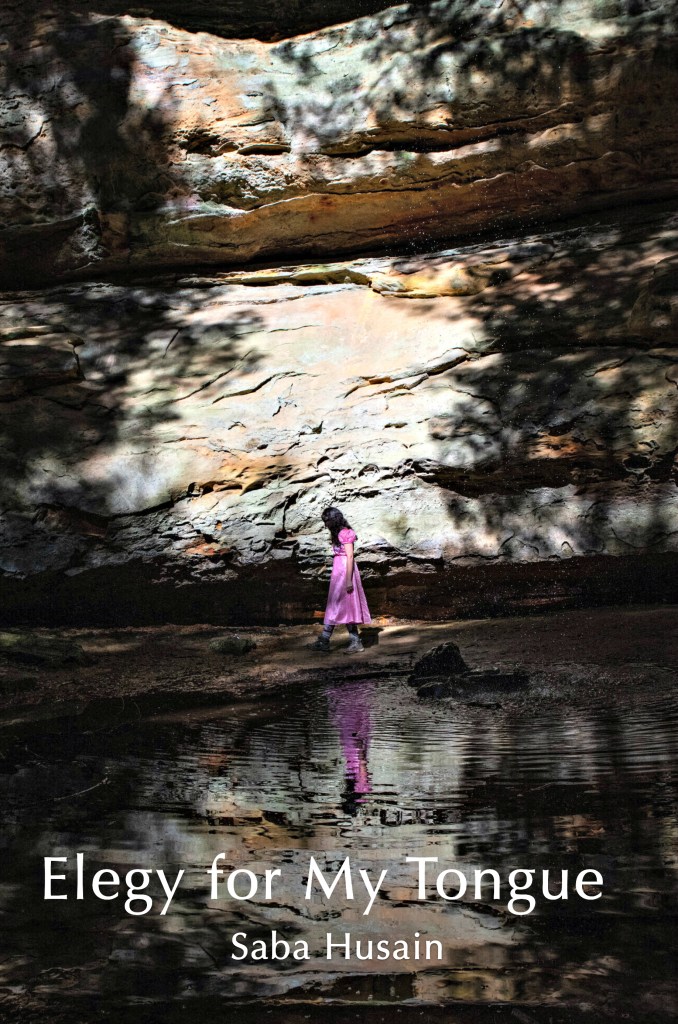
Elegy for My Tongue
Both time and the self are circles in Saba Husain’s Elegy for My Tongue, a collection that continues to ask where we begin—where now begins—when we carry our cultures, our histories, and our heritages with us. The timeline of colonialism and Partition may seem linear to an outsider, but inhabiting Husain’s poems is to live inside all time at once, to enter a world in which the diaspora is a perspective, a way of making everywhere and nowhere home, of infusing a single moment with all the past and future it carries. Through her eyes, we see Karachi, Mecca, and Katy, Texas as vibratingly alive, inhabited by our speaker’s startling attention to detail and the ancestors she conjures with the spell of her memories. “When there is nothing,” Husain tells us, “there will be words.” And if the words are these words in Elegy for My Tongue, there is hardly nothing; Husain’s words contain worlds.
— Cait Weiss Orcutt, VALLEYSPEAK (Zone 3 Press, 2017)
ORDER NOW



COMMENTS
from readers for the Perugia Press Prize
“A book of negotiation between past and present, Texas and Pakistan, English and Urdu, of faith, prayer, and the transcendent. Poems honor the father, the grandfather, and ancestors, and are an inheritance for the speaker’s grandson. They occupy the liminal space of an immigrant and speak to aging, dying, becoming part of history.”
“There are beautiful, surprising, and deeply moving poetic moments, often at the end of poems. “We sop tendrils in tears”; “let the moon orbit your eyes”; “my bones bloom”; “the inquiry of leaves.” There is an incredible tenderness in all these poems, especially regarding the speaker’s grandson. Deep love, fear, grief and fragility.”
“Musical, lyrical. So many of these poems I wish to memorize- roll around in memory.”
“Graceful, elegant poems that grapple with language, bigotry, family, legacy, environment. Masterful sounds. Just listen to: “A speechless broken old woman/ shows the hazel eyed girl the okra that grows/ on the stalk.” Say that out loud-my goodness!”
“Pastoral, musical, line sense is very keen, language is rich and rooted and I am drawn in vs watching as a reader.”

